What makes Bangkok one of the world’s great cities for food?
Few cities eat the way Bangkok does. Food is everywhere, at every hour, at prices that make it accessible to almost anyone who lives here or visits. A bowl of boat noodles at a canal-side stall costs less than a cup of coffee in most European capitals. The same city, on the same evening, has tables where a tasting menu and wine pairing reach the equivalent of several hundred dollars. The gap between those two things is present in Paris or Tokyo too, but Bangkok is one of the few cities where both are considered serious, where the street cook and the starred chef are part of the same food culture rather than parallel worlds that pretend the other does not exist.
Three things sustain this. The first is ingredient quality. Thailand’s produce, its fresh herbs, river fish, Gulf seafood, tropical fruits and vegetables, is genuinely extraordinary, and it is the same produce that both the noodle shop and the three-star kitchen work with. The second is the cultural weight given to food. Eating well is a daily priority in Bangkok, not a weekend luxury, and that attitude shapes everything from the wet market at 6 a.m. to the service standards in the city’s finest dining rooms. The third is the concentration of culinary talent the city has accumulated: Thai chefs who trained abroad and came home, and internationally-minded cooks from other countries who chose Bangkok as a permanent base because of what the city offered them.
The result is a dining scene that competes with the established capitals of Asia, not by imitating them, but by doing something they cannot.
Where does Bangkok’s food culture actually come from?
Bangkok’s food identity is the product of several distinct histories running in parallel. Royal Thai cuisine, developed in palace kitchens over centuries, is elaborate and technically demanding: layered sauces, precise spicing, dishes originally intended to mark the seasons and occasions of court life. That tradition is still alive in restaurants like R-Haan, which holds Two MICHELIN Stars on Sukhumvit Soi 53.
Chinese immigration into Bangkok over several centuries created the Yaowarat district, now one of the world’s great street food corridors. The Sino-Thai food culture that developed there, from the roast duck shops to the dim sum houses, remains a defining part of how Bangkok eats. Potong, one of the city’s MICHELIN-starred restaurants, is based in Chinatown and draws directly from that history in its cooking.
Southern Thai cooking, the most distinctive and ingredient-specific of Thailand’s regional traditions, is represented at the highest level by Sorn on Sukhumvit Soi 26, the first Thai restaurant in history to hold Three MICHELIN Stars. Northern Thai cooking from Chiang Mai influences a separate set of kitchens and street stalls across the city. Bangkok is, in this sense, not a single cuisine but a field where multiple Thai food traditions coexist, compete and occasionally combine.
Cutting across all of them is the Buddhist vegetarian tradition. Thailand’s Buddhist and Taoist communities have maintained serious plant-based cooking for generations, meaning Bangkok’s restaurants have long operated with an understanding of meatless cooking that most European cities acquired only recently.
The MICHELIN Guide arrived in Thailand in 2017. It provided a formal international index for something that already existed. What it accelerated was the global visibility of Bangkok’s fine dining scene and the investment by Thai chefs and restaurateurs in rooms designed to compete on an international stage.
What kinds of restaurants does Bangkok’s dining scene contain?
Bangkok’s restaurant landscape spans more categories than most cities manage across all price points combined.
Street food is the foundation. The hawker cart, the noodle shop, the roadside grill, the wet market stall: these are where most Bangkokians eat daily. Jay Fai, the solo wok cook in Banglamphu who holds One MICHELIN Star, represents the point where the street food tradition and the starred dining world formally intersect.
Neighbourhood restaurants, the mid-market Thai places, the family-run Japanese, Korean and Indian kitchens that serve Bangkok’s residential areas, form the largest category by number. These require no reservation and no dress code but often involve accomplished, consistent cooking.
The fine dining tier, which the MICHELIN Guide covers, runs from formal hotel restaurants to the new generation of independent chef-patron houses. The balance between these two categories has shifted significantly over the last decade. Bangkok’s fine dining scene was once dominated by hotel restaurants. Today the city’s most-discussed and most-awarded restaurants are mostly independent: Sorn, Sühring, Haoma, Potong, Mia. The hotel kitchens that remain at the top, including Chef’s Table and Mezzaluna at lebua, compete on the same terms as the independents.
Which Bangkok neighbourhoods are best for dining?
Bangkok is a large city and its dining scene is distributed across several corridors.
Sukhumvit Soi 26 is Bangkok’s most decorated single street for fine dining. Sorn (Three MICHELIN Stars, 56 Soi 26) and Mia (One MICHELIN Star, 30 Attha Kawi 1, Soi 26) are both here, a short walk from BTS Phrom Phong. The soi runs deeper into a quiet residential cluster and holds a concentration of restaurants at every level alongside the two starred addresses.
The Sukhumvit corridor more broadly, from Soi 11 to Soi 55, holds several more starred kitchens. Haoma is on Soi 31 and R-Haan on Soi 53.
Silom-Sathorn, the business district south of the centre, holds Maison Dunand (Cuisine of the Alps, One Star, Sathorn Soi 10), Samrub Samrub Thai, and Nahm at the Como Metropolitan Bangkok.
Soi Langsuan holds two Two-Star restaurants within minutes of each other: Gaa, where Chef Garima Arora applies Indian technique to Thai produce, and INDDEE, whose wine programme was named Best Medium-Sized Wine List in the World at the Star Wine List of the Year Awards 2025.
Yen Akat, south of Silom in the Sathorn district, is where Sühring occupies a restored 1970s villa with a kitchen garden and glass dining room. It holds Three MICHELIN Stars as of the 2026 edition, the first German restaurant in Asia to reach that level.
Chinatown, the Yaowarat district, offers the densest street food experience in Bangkok alongside Potong (One MICHELIN Star), which draws from Sino-Thai culinary history in its cooking.
The Chao Phraya riverfront and its landmark hotels hold Bangkok’s most formal dining rooms: Anne-Sophie Pic at Le Normandie (Two Stars, Mandarin Oriental), Côte by Mauro Colagreco (Two Stars, Capella Bangkok), Mezzaluna (Two Stars, lebua at State Tower) and Blue by Alain Ducasse (One Star, ICONSIAM). These are hotel-backed rooms distinct from the independent chef-patron houses elsewhere in the city.
Which Bangkok restaurants are considered the best in 2026?
The MICHELIN Guide Thailand 2026, announced 27 November 2025, provides the most consistent international benchmark. Bangkok holds 43 starred restaurants in the current edition.
At the Three-Star level, Sorn and Sühring are the two tables the guide considers to represent the best cooking in Thailand. Sorn, under Chef Supaksorn “Ice” Jongsiri, was the first Thai restaurant in history to reach Three Stars. Sühring was promoted to Three Stars in the 2026 edition. Both require weeks or months of advance booking.
The Two-Star field spans: royal Thai at R-Haan; contemporary Indian at Gaa and INDDEE; garden-driven Thai at Baan Tepa; and the riverfront hotel rooms Anne-Sophie Pic at Le Normandie, Côte by Mauro Colagreco, Chef’s Table and Mezzaluna.
The One-Star field of 33 restaurants is the widest and most varied tier. Among the most discussed in 2026: Haoma (neo-Indian, Sukhumvit Soi 31), Potong (Sino-Thai, Chinatown), Samrub Samrub Thai (Silom), Maison Dunand (Cuisine of the Alps, Sathorn), Elements Inspired by Ciel Bleu, Coda, Wana Yook, and Mia (Asian heart and European craft, Sukhumvit Soi 26).
How does Bangkok’s fine dining compare to other Asian food cities?
Tokyo holds more MICHELIN stars than any other city in the world by a significant margin. Singapore has a mature and internationally recognised fine dining scene. Hong Kong, Seoul and Taipei each have their own distinct restaurant cultures. Bangkok is not attempting to replicate any of them.
What distinguishes Bangkok in 2026 is a combination of three things few other Asian cities have managed simultaneously: the quality and variety of local ingredients, the concentration of independent chef-patron restaurants operating at the top level, and the price-to-quality ratio that applies across all tiers.
Bangkok’s finest restaurants are mostly independently owned and chef-driven. This matters because the cooking is shaped by individual perspective and culinary commitment rather than by hotel brand standards or investor expectations. The result is a more diverse and more interesting starred field than in cities where hotel restaurants still dominate.
The ingredient quality is a structural advantage. Thailand’s agricultural output, its coastal seafood, its herbs and spices, gives Bangkok’s kitchens access to produce that other Asian capitals have to import at higher cost. That flows through to tasting menu prices that are competitive with Tokyo or Singapore while offering comparable cooking quality.
Bangkok is also the only city in Southeast Asia with two Three-Star restaurants as of 2026. For food travellers planning a trip specifically around dining at the highest level, it is now a primary destination, not an alternative.
Where does Mia fit within Bangkok’s dining landscape?
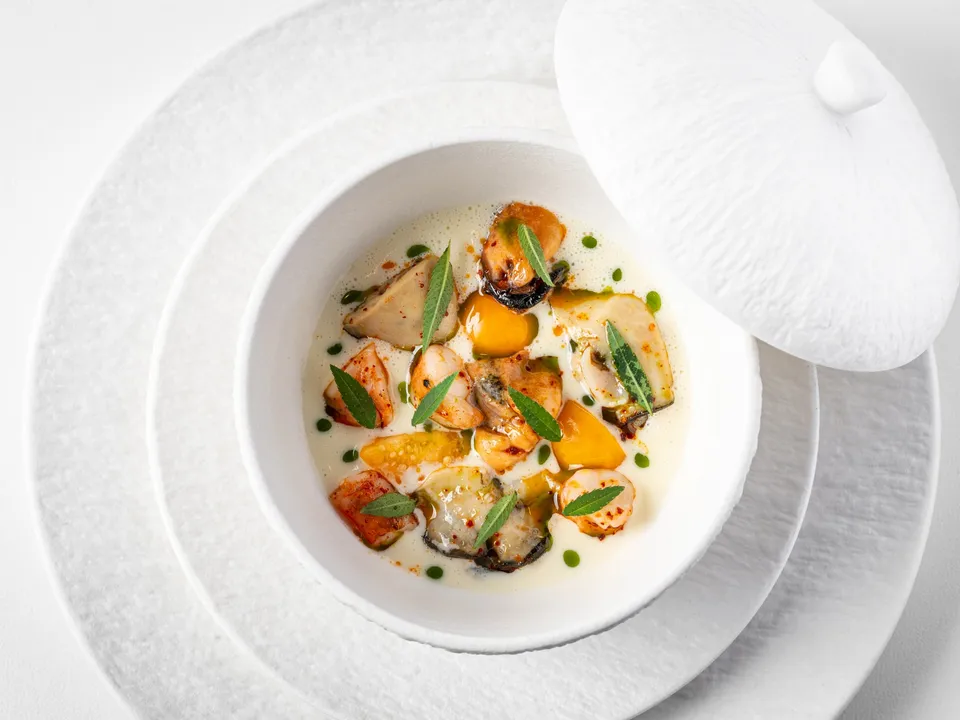
Mia holds One MICHELIN Star in the 2026 edition, in a restored heritage home on Sukhumvit Soi 26. The kitchen is led by husband-and-wife Chef-Patrons Pongcharn “Top” Russell and Michelle Goh, whose positioning is precise: Asian heart, European craft.
Within Bangkok’s starred field, several things set Mia apart at the planning stage. It is open on Monday, genuinely rare at this level in the city. It runs 3 simultaneous tasting menus, standard, vegetarian and vegan, each built at the same level of composition rather than adapted from a single menu. Weekend lunch is available on Saturdays and Sundays. The restaurant is a short walk from BTS Phrom Phong, with tasting menus from THB 5,250++ per person at dinner.